变革与展望:新《商标法》25项重点修订中英文对照与实务解读
2026年6月26日,第十四届全国人民代表大会常务委员会第二十三次会议表决通过新修订《中华人民共和国商标法》(以下简称“新法”),将于2027年1月1日起施行。这是《商标法》自1983年实施以来的第五次修订。相较于2019年修法主要针对恶意商标注册等问题进行的局部修改,本次修法对商标制度进行了比较全面的修订和完善。
On June 26, 2026, the Standing Committee of the 14th National People's Congress adopted the revised Trademark Law of the People's Republic of China (the "Trademark Law"), which will take effect on January 1, 2027. This is the fifth amendment to the Trademark Law since it came into force in 1983. Compared with the 2019 amendment, which focused primarily on addressing bad-faith trademark filings, the current revision introduces a much broader range of reforms to China's trademark system and represents a significant development in the country's trademark legal framework.
本文结合新旧法条对比,梳理本次修法的25项主要修订内容,并结合立法背景及司法实践,对相关制度变化及其可能产生的实务影响进行分析,以供业界参考。
This article provides a side-by-side comparison of the previous and revised provisions, highlighting 25 key amendments introduced by the revised Law. It also analyzes the legislative background, the key changes, and their potential practical implications for industry stakeholders.
一、总则部分 General Provisions
1.明确互联网等信息网络中的商标使用 Trademark Use through the Internet and Other Information Networks
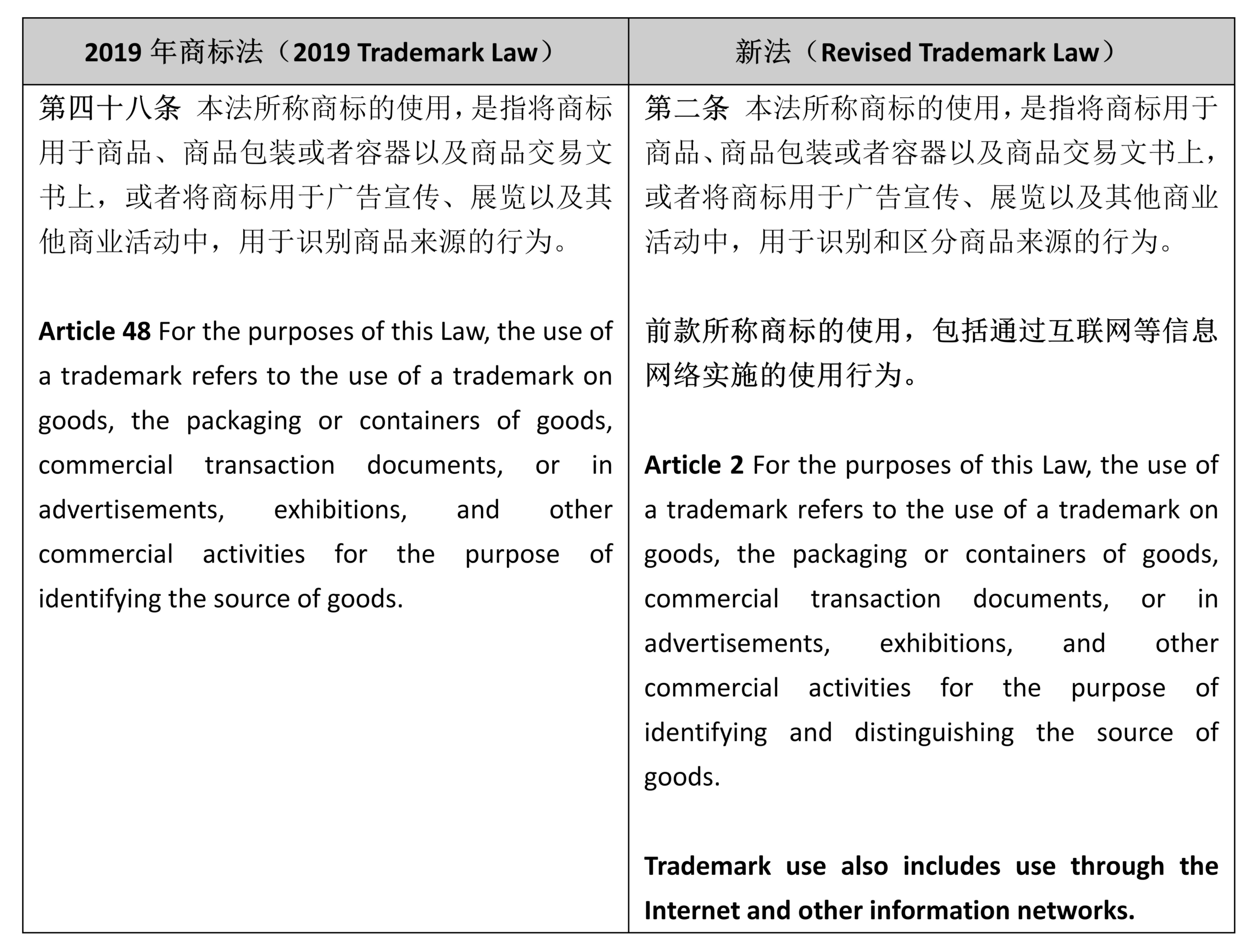
修改解读:新法明确将通过互联网等信息网络实施的商标使用纳入商标使用的范围,为网络环境下商标使用的认定提供了更加明确的法律依据。该修改预计将对撤销连续三年不使用注册商标案件中的使用证据认定产生积极影响,但如何认定互联网使用在不同国家和地区的法律效力,仍有待进一步探索。
Comments: The revised Law expressly recognizes trademark use through the Internet and other information networks, providing a clearer legal basis for determining trademark use in the online environment. The amendment is expected to have a positive impact on the assessment of use evidence in non-use cancellation proceedings. However, how online trademark use should be assessed across different jurisdictions, particularly in light of the territorial nature of trademark rights, remains to be further explored.
2.新增禁止滥用商标权原则 Prohibition of Abuse of Trademark Rights
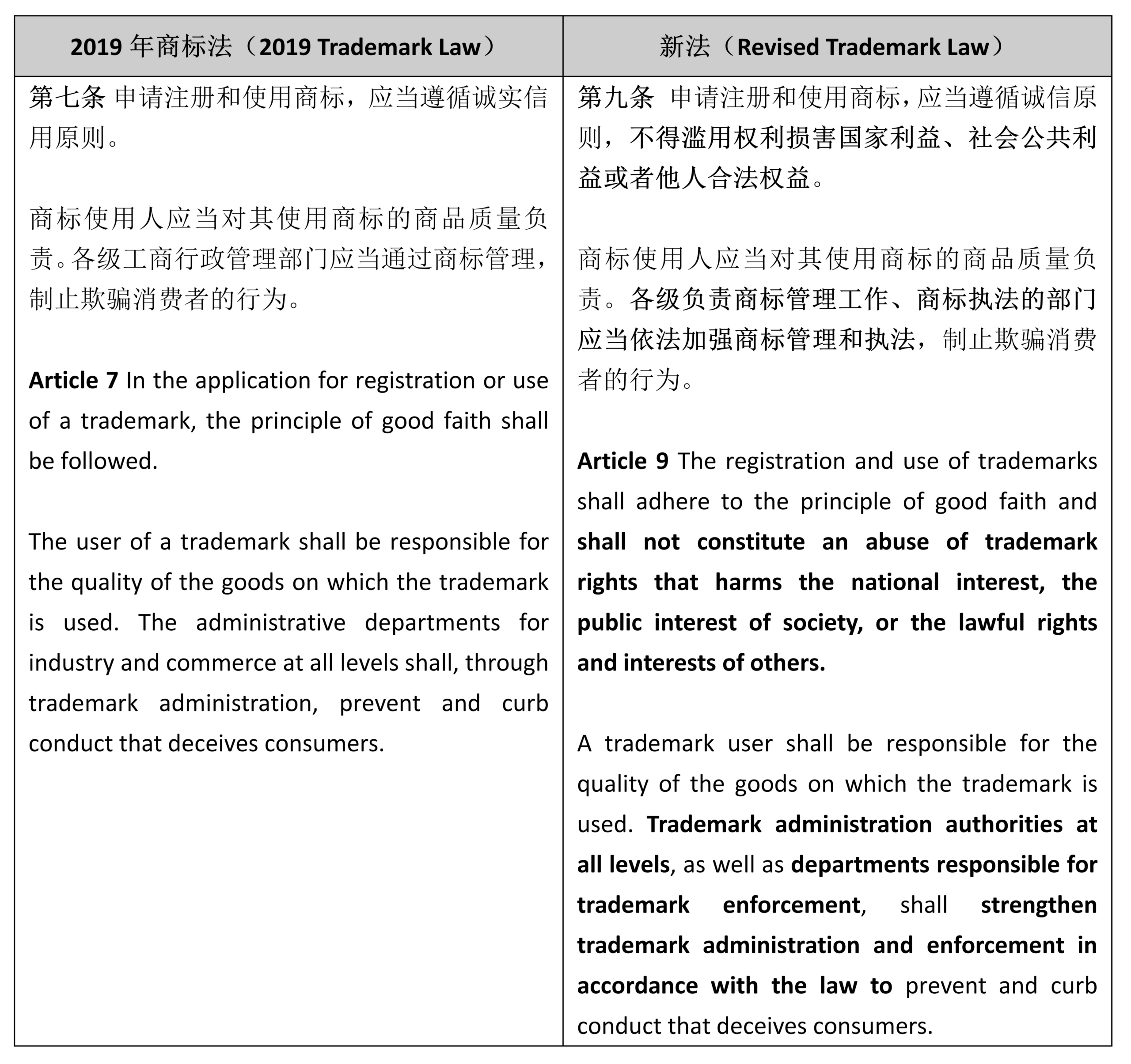
修改解读:新法明确规定禁止滥用商标权,将诚实信用原则进一步具体化,为规制恶意商标注册、恶意维权等行为提供了更加明确的法律依据。该规定是对近年来司法实践中规制滥用商标权典型案例的总结和提炼,体现了我国持续倡导诚实信用原则、禁止滥用商标权的司法导向。
Comments: The revised Law expressly prohibits the abuse of trademark rights, further reinforcing the principle of good faith and providing a clearer legal basis for addressing bad-faith trademark filings and abusive enforcement practices. This provision summarizes and codifies the principles established in recent judicial decisions addressing the abuse of trademark rights, reflecting China's continued judicial commitment to the principles of good faith and the prohibition against the abuse of trademark rights.
3.扩大商标申请主体范围 Expanded Eligibility for Trademark Applicants
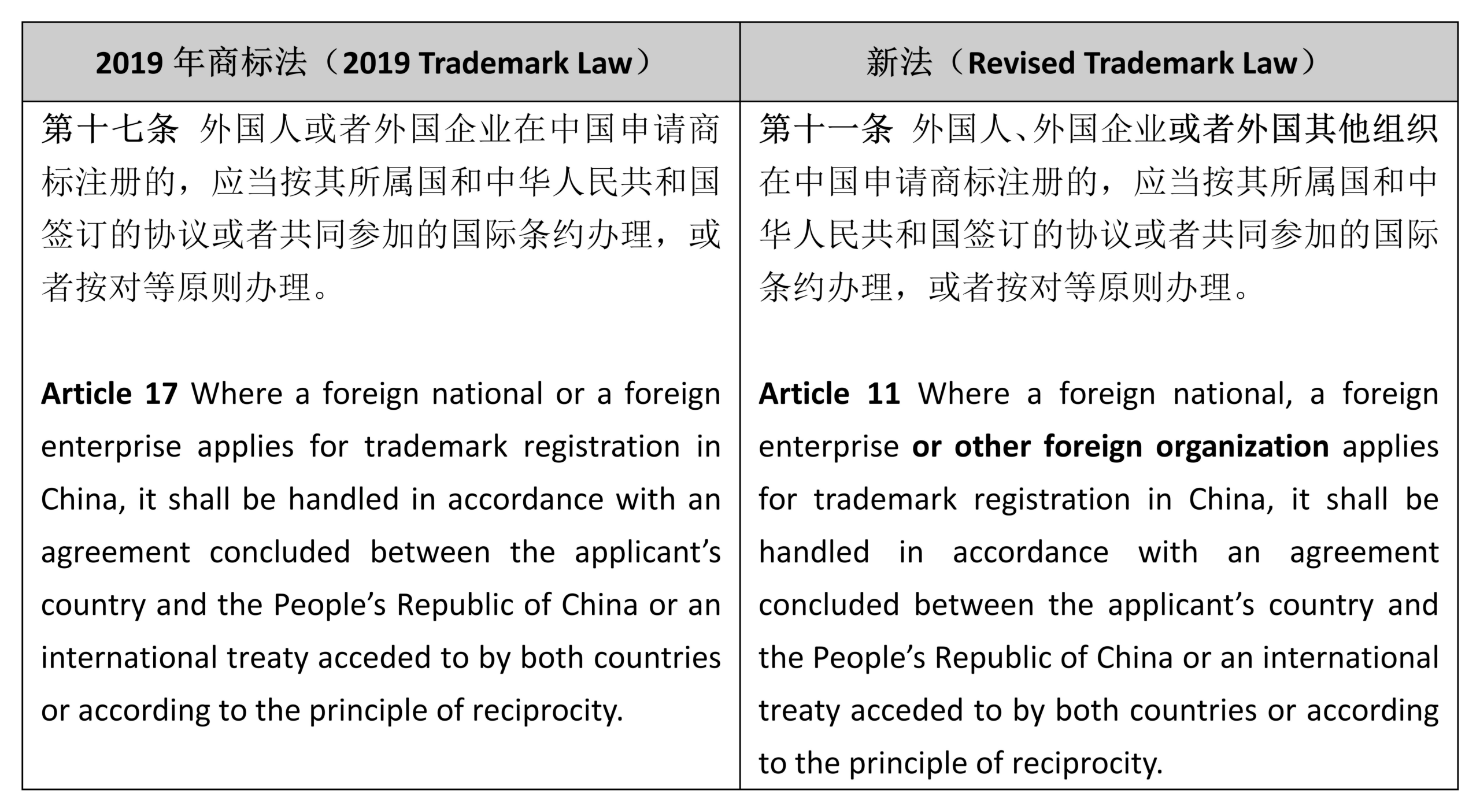
修改解读:新法将“外国其他组织”明确纳入商标申请主体范围,与我国长期以来的商标审查实践保持一致,进一步完善了商标申请主体制度,为外国其他组织在中国申请商标注册提供了更加明确的法律依据。
Comments: The revised Law expressly includes "other foreign organizations" as eligible applicants for trademark registration, bringing the statutory language into line with long-standing trademark examination practice in China. The amendment provides a clearer legal basis for other foreign organizations to apply for trademark registration in China.
二、商标注册条件 Trademark Registration Requirements
4.新增动态商标 Inclusion of Dynamic Signs
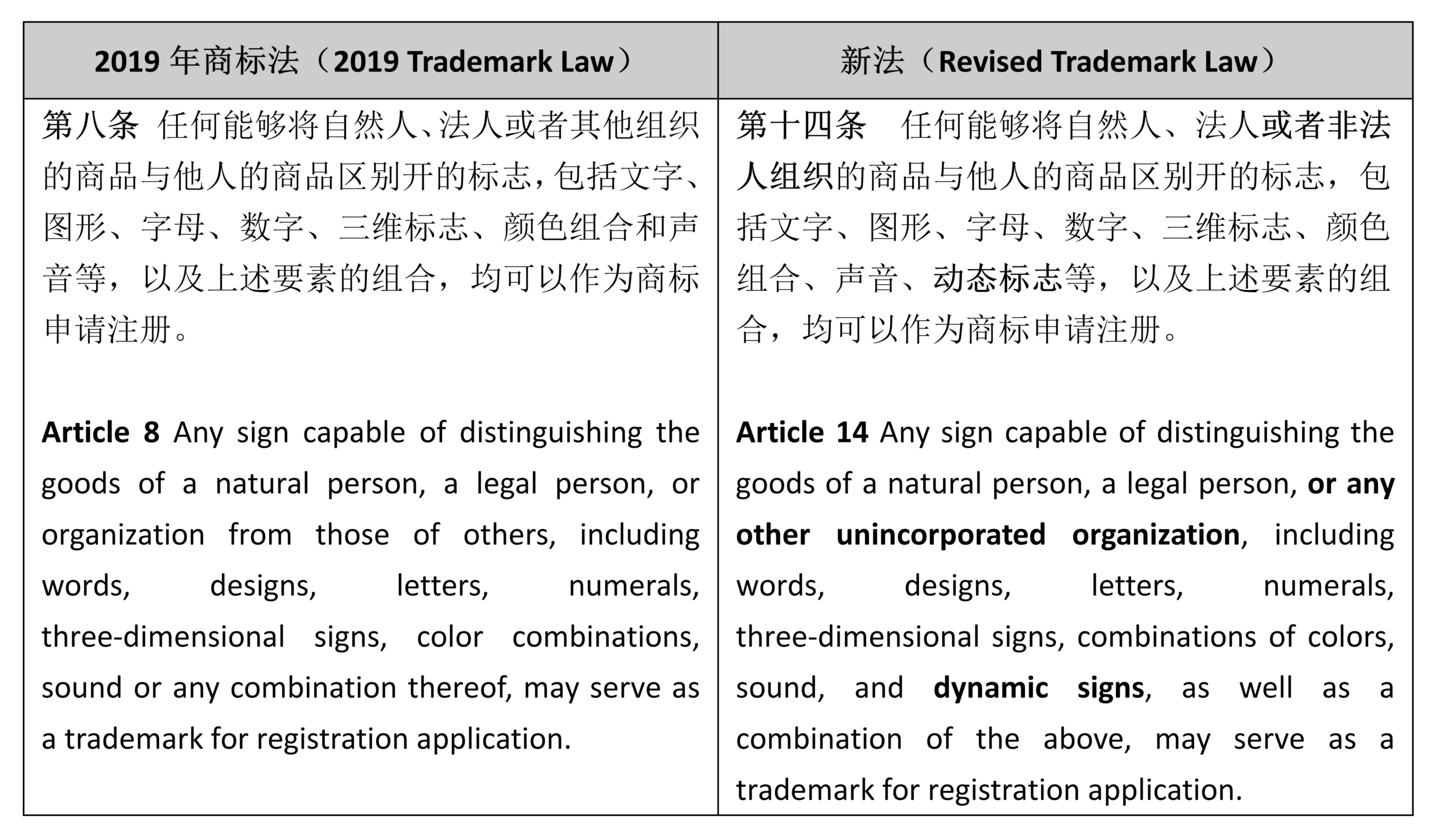
修改解读:新法首次明确将动态标志纳入可注册商标范围,进一步扩大了可注册商标客体的范围,以适应数字经济时代品牌标识的发展趋势。对于使用动态Logo、开机动画、应用程序启动画面等动态品牌标识的企业,可结合品牌保护策略,适时申请动态商标注册。值得注意的是,新法采用“动态标志等”的表述,也为未来其他新型标志纳入商标注册保护范围预留了一定的空间。
Comments: The revised Law expressly recognizes dynamic signs as registrable trademarks, expanding the scope of registrable trademark subject matter to accommodate evolving forms of brand identity in the digital era. The companies using animated logos, startup animations, application launch screens or other dynamic branding elements may consider filing applications for dynamic trademarks in China as part of their brand protection strategy. It is also worth noting that the use of the expression "dynamic signs and the like" may leave room for future recognition of other new types of signs as registrable trademark subject matter.
5.新增中国共产党相关标志性要素的禁止注册和使用规定 Symbolic Elements of the Communist Party of China
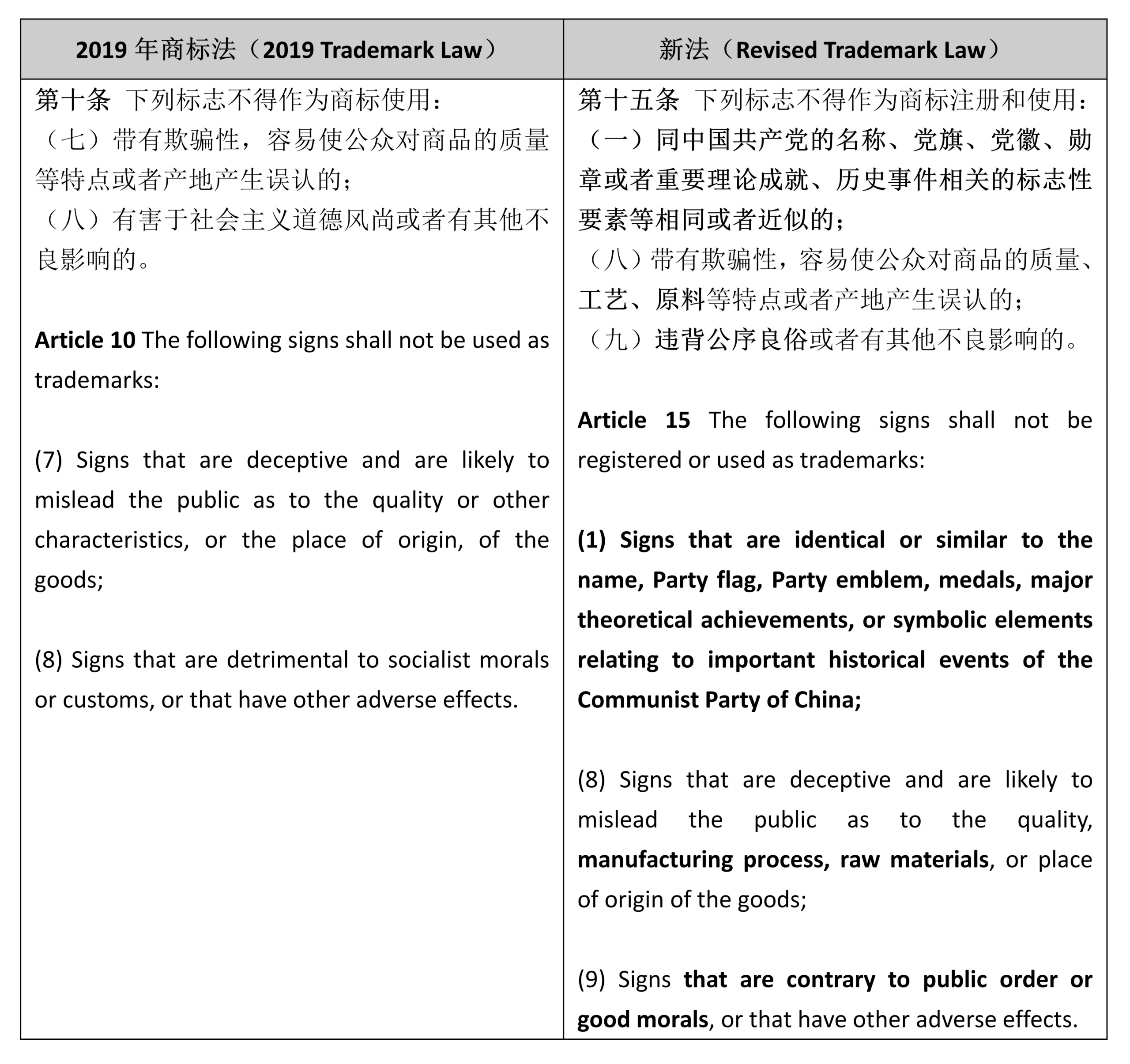
修改解读:新法将与中国共产党名称、党旗、党徽、重要理论成就、历史事件相关的标志性要素明确纳入禁止注册和使用的范围,进一步完善了禁止注册和使用标志制度。品牌所有人在申请和使用商标时,应关注相关规定,加强商标检索和品牌命名的合规审查。
Comments: The revised Law expands the list of prohibited signs by expressly including symbolic elements relating to the Communist Party of China. Brand owners should take this amendment into account when conducting trademark clearance and selecting new brands.
6.地名及特殊标志 Geographical Names and Special Signs
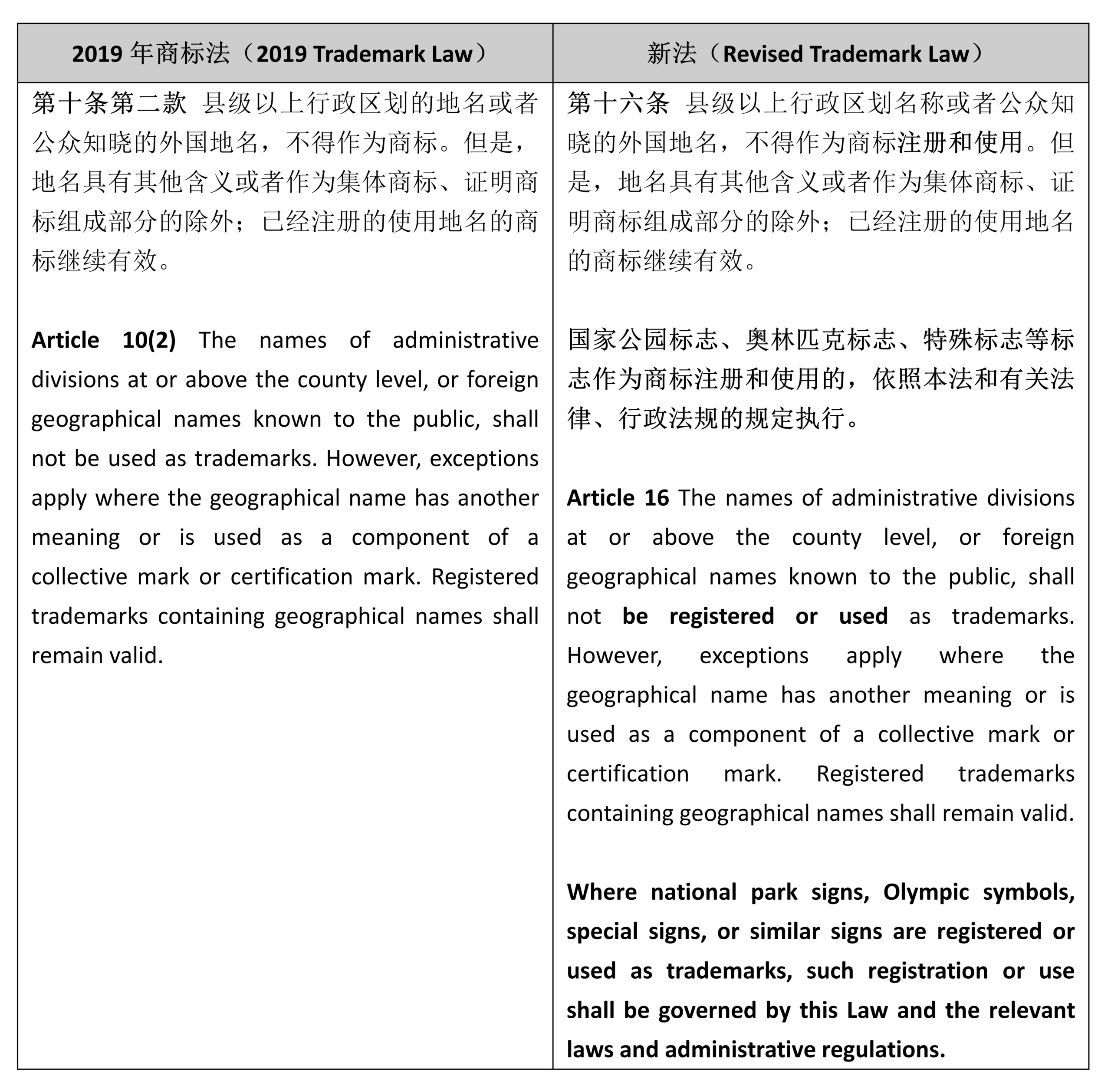
修改解读:新法将县级以上行政区划名称或者公众知晓的外国地名由“不得作为商标”调整为“不得作为商标注册和使用”,进一步明确了相关地名在商标注册和使用两个环节的禁止性要求。同时,新法新增规定,国家公园标志、奥林匹克标志、特殊标志等作为商标注册和使用的,适用《商标法》及有关法律、行政法规的规定。品牌所有人在中国进行商标检索、品牌命名和商标使用时,应进一步关注地名及特殊保护标志的合规风险。
Comments: The revised Law changes the wording from geographical names being prohibited from being “used as trademarks” to being prohibited from being “registered or used as trademarks”, making the prohibition more explicit at both the registration and use stages. It also adds a new paragraph clarifying that the registration and use of national park signs, Olympic symbols, special signs and similar signs as trademarks shall be governed by the Trademark Law as well as relevant laws and administrative regulations.
7.完善恶意商标申请的规制规则 Consolidation of Bad Faith Filing Rules
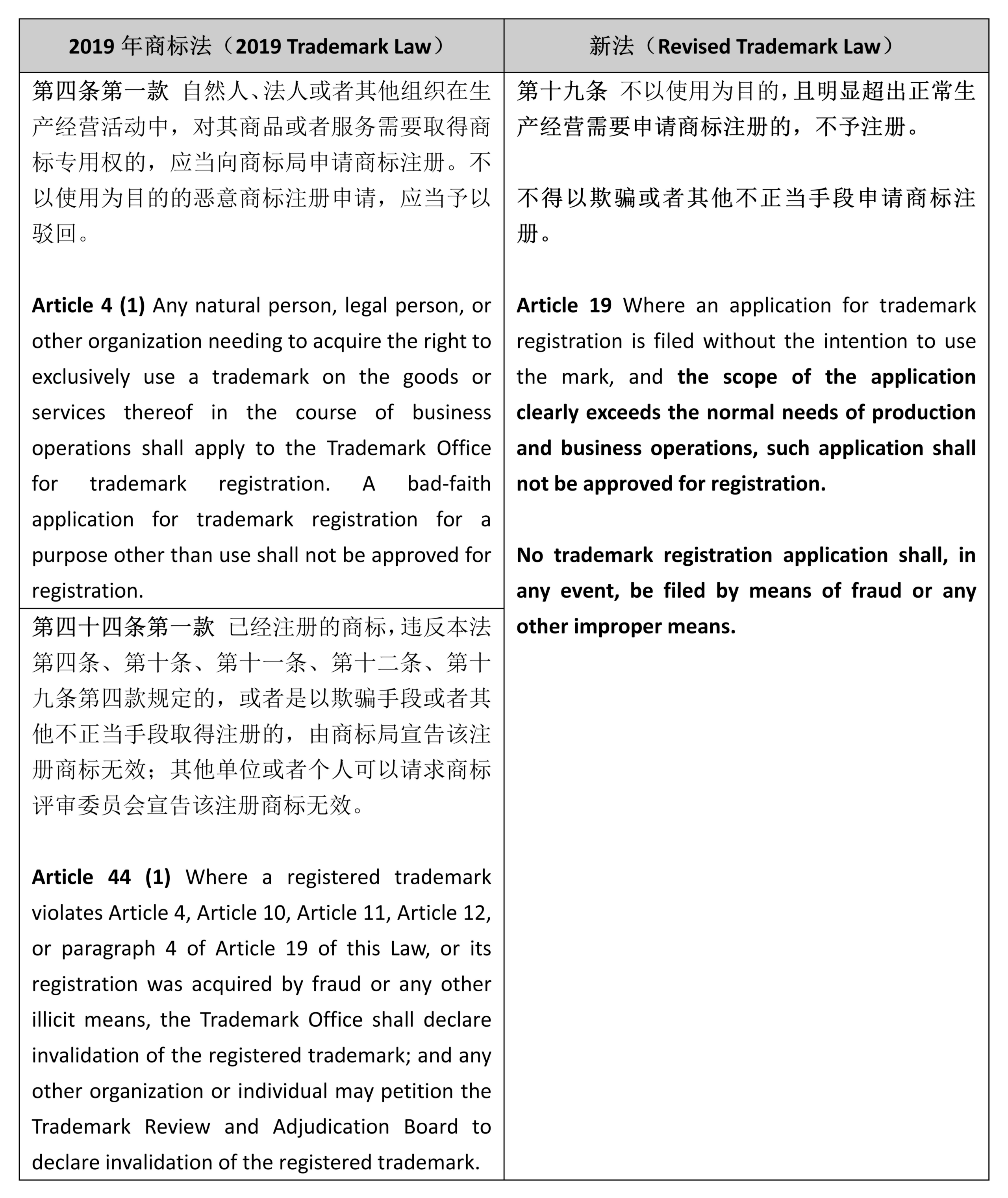
修改解读:打击恶意商标申请一直是近年来商标行政和司法保护的重要方向。2019年《商标法》第四条确立了“不以使用为目的”的基本规则,经过近七年的行政执法和司法实践,逐步形成了相对明确的适用标准。本次修法将恶意商标申请的构成要件统一调整为“不以使用为目的,且明显超出正常生产经营需要申请商标注册”,同时适用于注册和未注册商标,进一步完善了恶意商标申请的认定标准。新标准在实践中的具体适用,特别是对防御性商标注册的影响,需要结合具体案例进行评估。
Comments: Combating bad-faith trademark filings has been a major focus of both administrative and judicial practice in recent years. The revised Law consolidates the bad-faith filing rules into a single standard, under which a trademark application will be refused where it is filed without a genuine intention to use and its scope clearly exceeds the normal needs of production and business operations. This amendment further clarifies the standard for determining bad-faith filings. Its application in practice, particularly in relation to defensive trademark filings, will need to be assessed in light of future cases.
8.新增未注册驰名商标的跨类保护 Cross-Class Protection for Unregistered Well-Known Marks
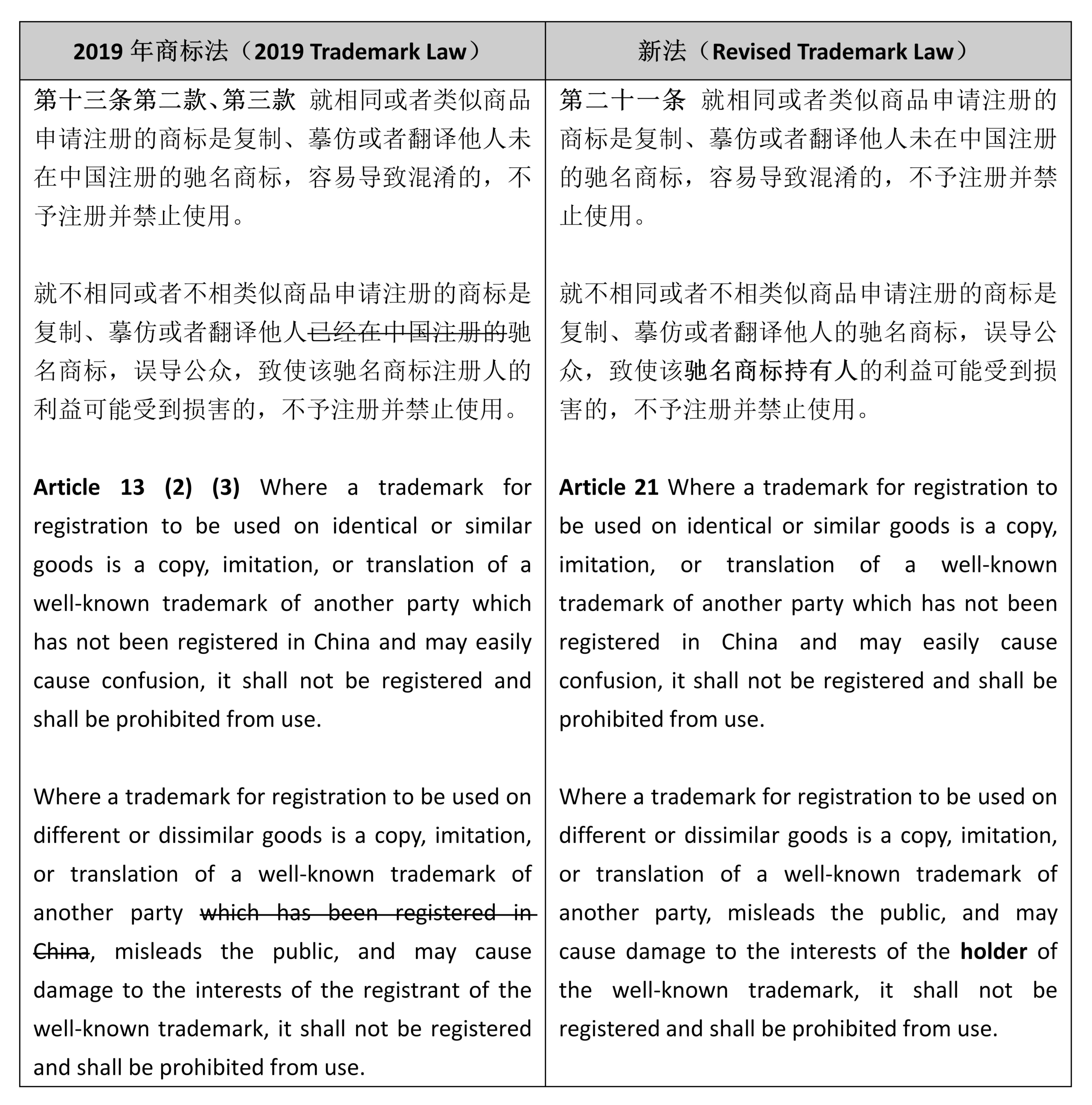
修改解读:新法将未注册驰名商标的跨类保护扩展至不同或者不类似商品,为未在中国注册但已在中国具有较高知名度的驰名商标提供了更广泛的保护。这一修改为海外商标在中国获得驰名商标保护提供了更加明确的法律依据,也体现了我国持续加强知识产权保护、不断优化营商环境的立法导向。
Comments: The revised Law extends cross-class protection to unregistered well-known trademarks. This amendment broadens the protection available to well-known marks that have not been registered in China but have established a strong reputation among the relevant public in China. It provides a clearer legal basis for overseas brand owners to obtain well-known trademark protection in China and reflects China's continued commitment to strengthening intellectual property protection and improving the business environment.
三、商标审查与核准制度的修订 Trademark Examination and Registration
9.缩短商标异议期 Shortened Opposition Period
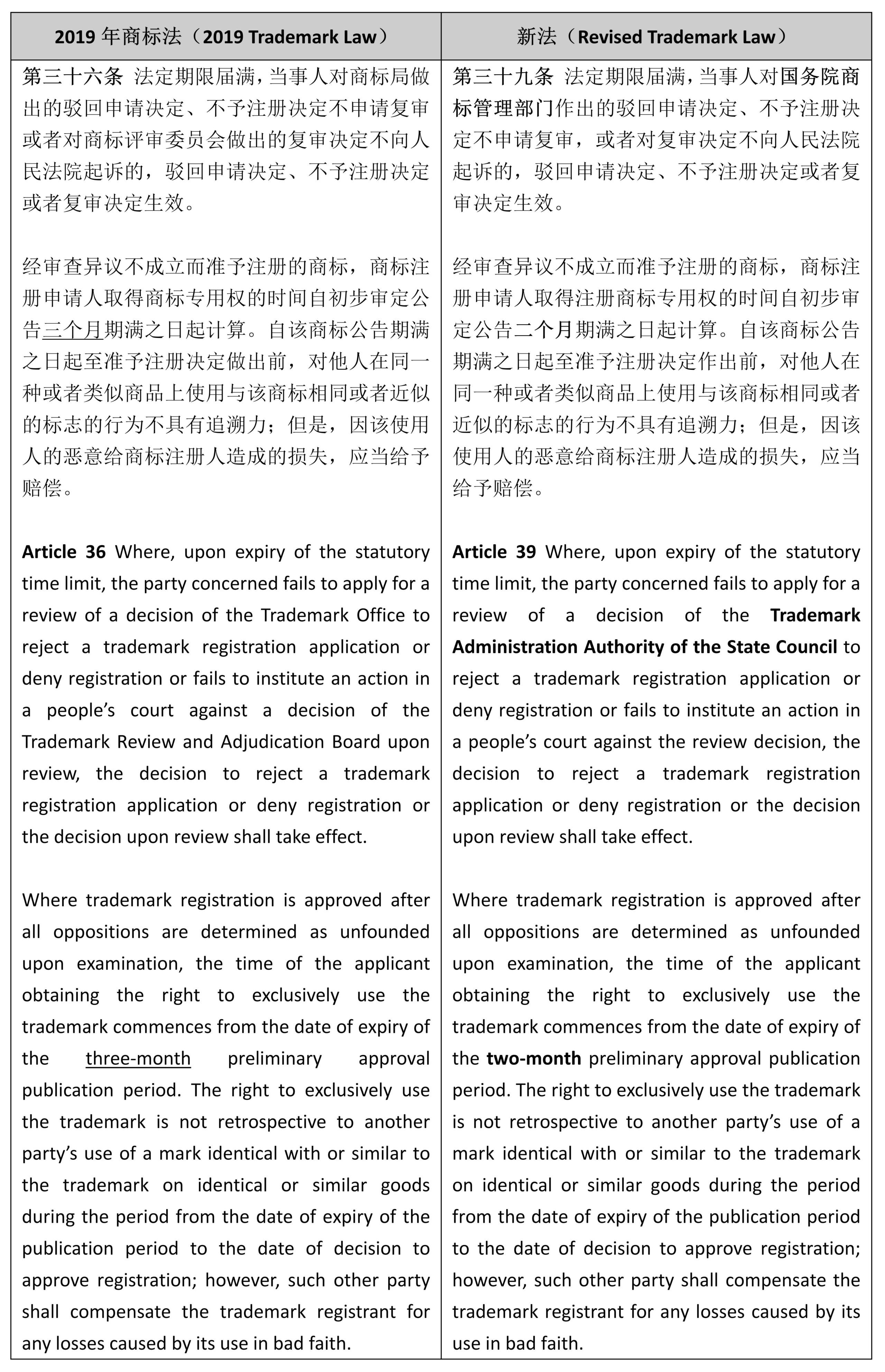
修改解读:新法将商标初步审定公告异议期由三个月缩短为二个月,进一步提高了商标注册审查效率,缩短了商标注册周期。品牌所有人应更加关注商标公告,及时监测和评估潜在冲突商标,并在法定期限内提出异议。
Comments: The revised Law shortens the opposition period from three months to two months, further improving the efficiency of the trademark registration process and reducing the time required to obtain registration. Brand owners should closely monitor newly published trademark applications, promptly assess potential conflicts, and file oppositions within the statutory time limit.
四、商标续展、变更、转让的修订 Trademark Renewal, Recordal of Changes and Assignment
10.缩小一年等待期的适用范围 Narrowing of the One-Year Waiting Period
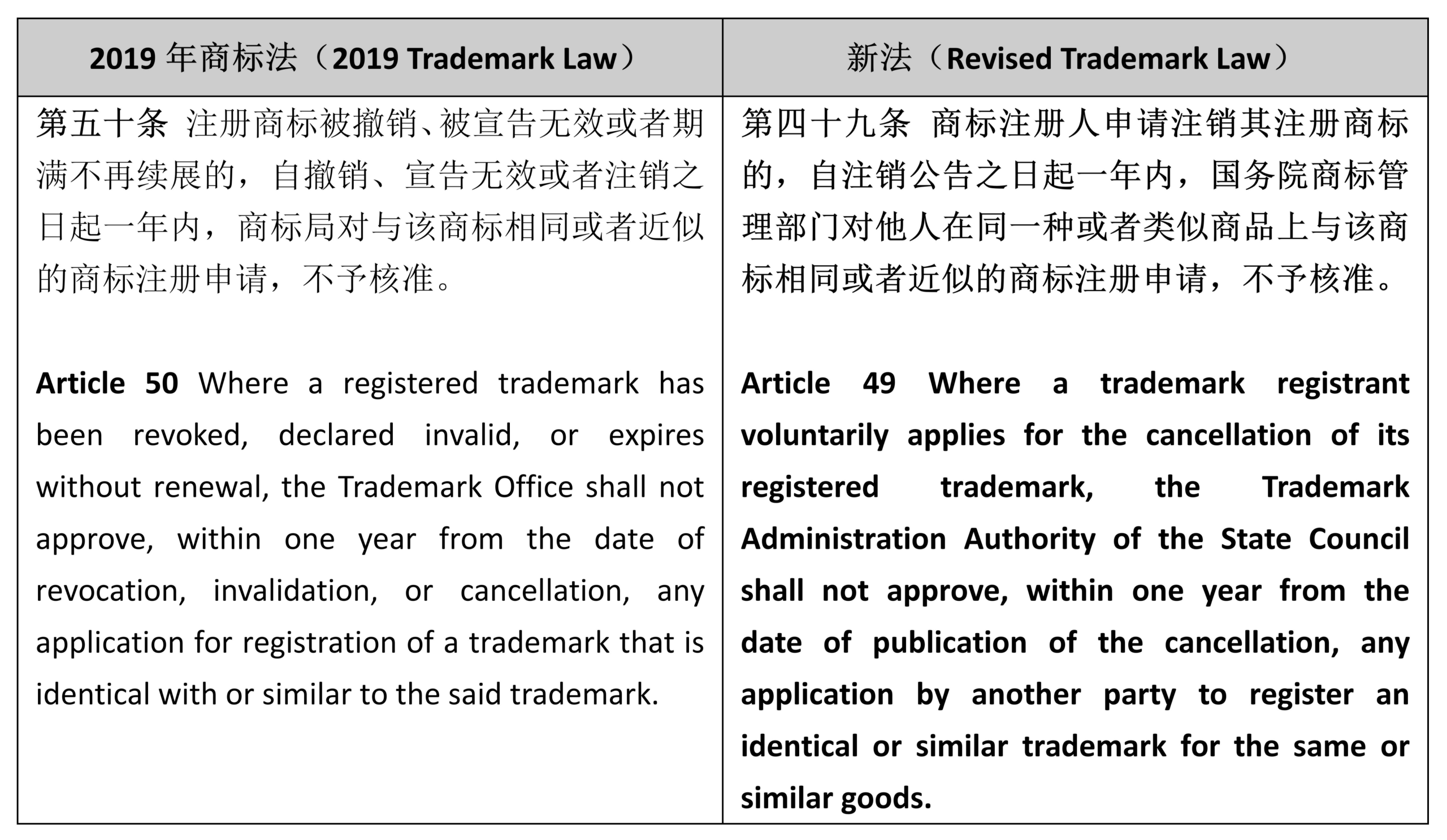
修改解读:新法将一年等待期的适用范围限定为注册商标主动申请注销的情形,不再适用于注册商标被撤销、宣告无效或者期满未续展等情形。该修改有助于大幅提高商标注册效率,也为申请人及时重新申请相关商标提供了更加便利的制度安排。
Comments: The revised Law limits the one-year waiting period to voluntarily cancelled trademarks and no longer applies it to trademarks that have been revoked, declared invalid, or expired without renewal. This amendment is expected to significantly improve the efficiency of trademark registration and provides applicants with greater flexibility to promptly refile identical or similar trademark applications.
五、商标管理 Trademark Administration
11.细化规定恶意商标申请行政处罚规则 Administrative Penalties for Bad-Faith Applications
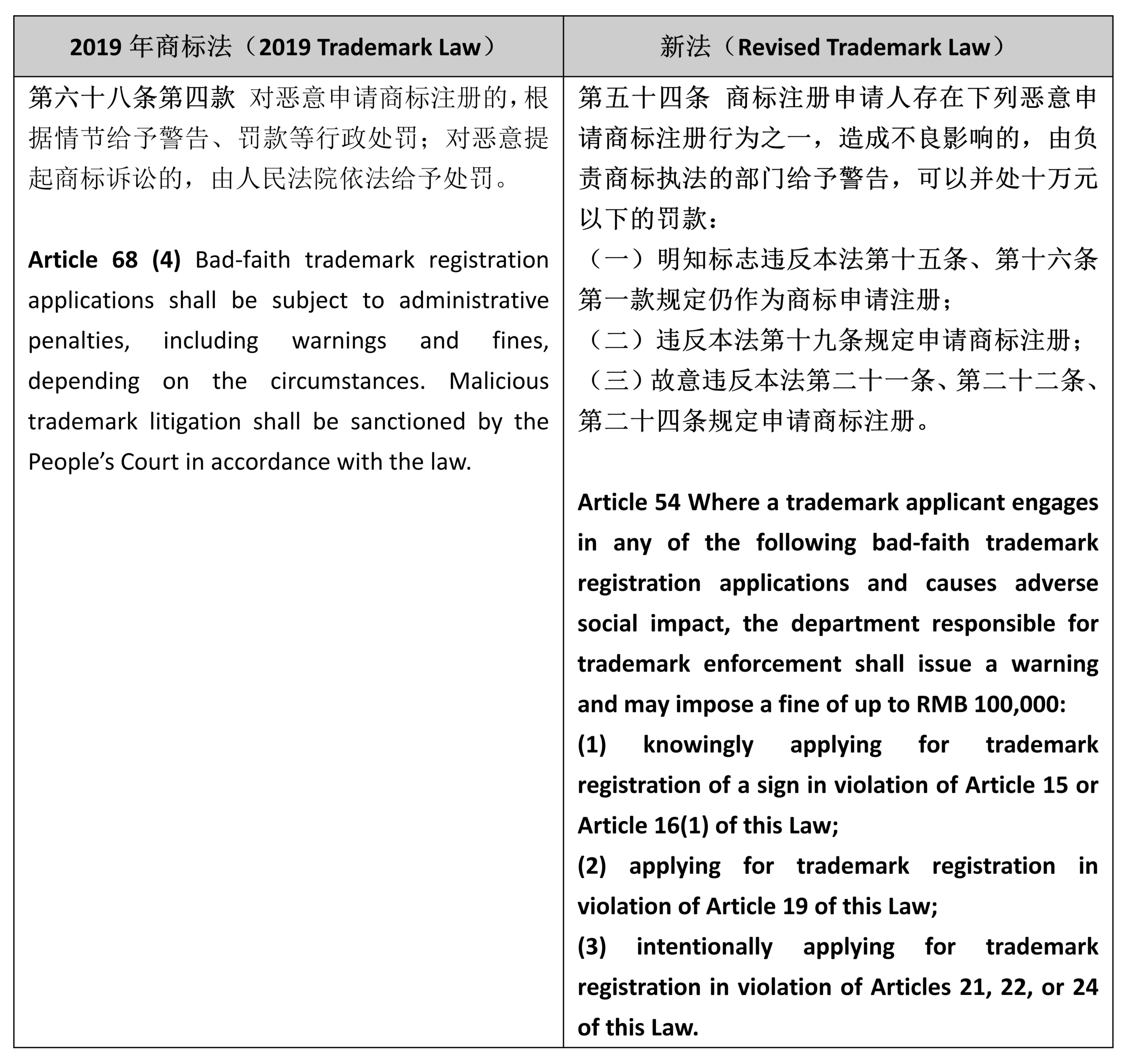
修改解读:2019年《商标法》已规定对恶意申请商标注册的,可以根据情节给予警告、罚款等行政处罚。本次修法进一步细化了恶意商标申请行政处罚的适用情形,明确列举了可以给予行政处罚的具体行为,包括明知属于禁用标志或者地名标志仍申请注册,违反恶意申请规则申请注册,以及故意申请注册与在先驰名商标、在先权利或者地理标志等相冲突的标志。该修改增强了恶意商标申请行政处罚规则的可操作性,有助于进一步维护正常的商标注册秩序。
Comments: The 2019 Trademark Law already provided administrative penalties for bad-faith trademark registration applications. The revised Law further refines the circumstances under which such penalties may apply by specifying the relevant categories of conduct, including knowingly applying to register prohibited signs or geographical names, filing applications in violation of the bad-faith filing rules, and intentionally applying to register signs that conflict with prior well-known trademarks, prior rights or geographical indications. This amendment enhances the operability of the penalty regime and helps maintain the normal order of trademark registration.
12.新增许可人解除商标使用许可合同的权利 Licensor's Right to Terminate Trademark License Agreements
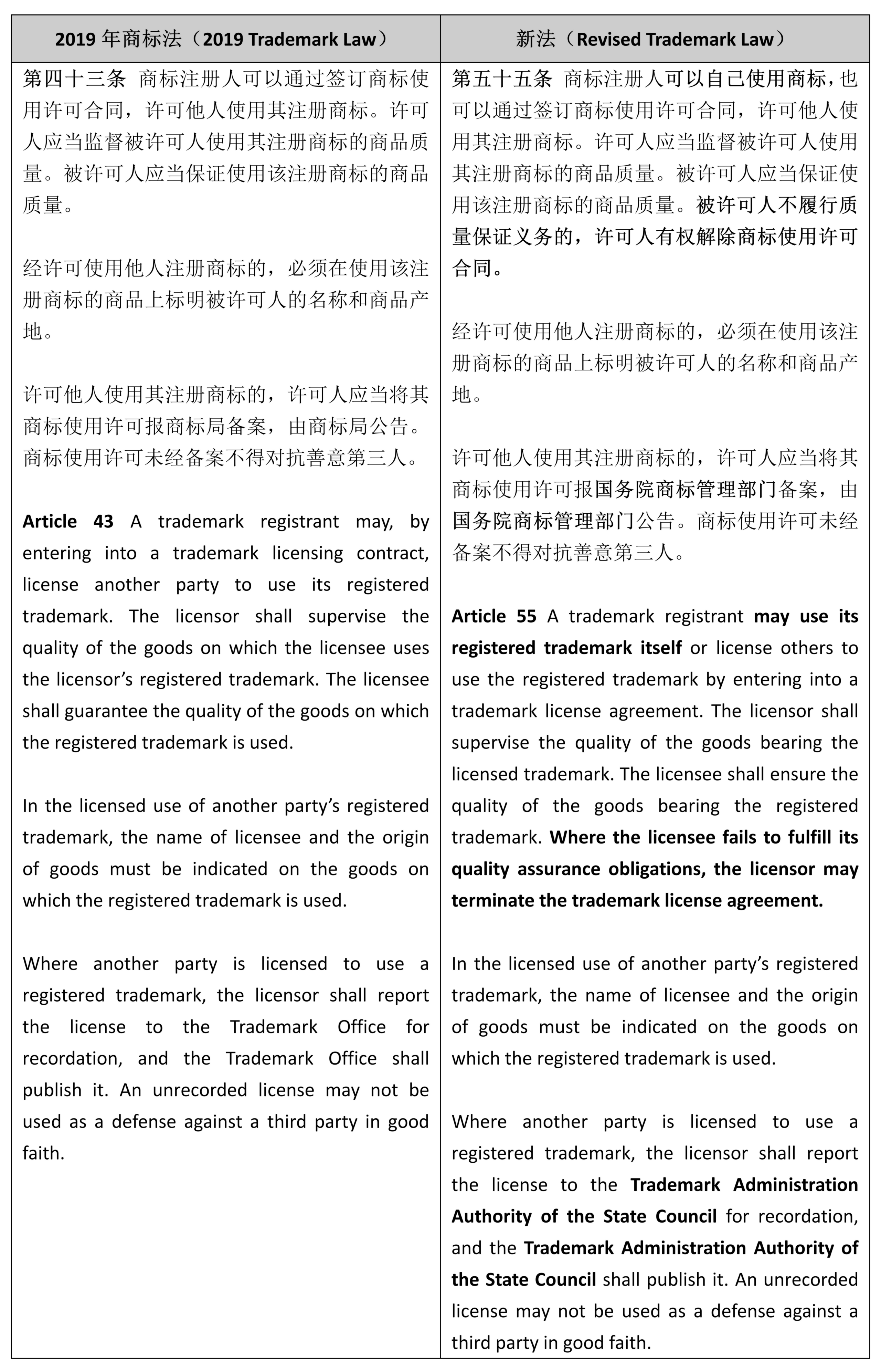
修改解读:新法明确规定,被许可人不履行商品质量保证义务的,许可人有权解除商标使用许可合同。该修改进一步强化了许可人在商标许可关系中的监督和控制义务,也为许可人在被许可人未能保证商品质量时及时终止许可关系提供了明确的法律依据。品牌所有人在签订和履行商标许可合同时,应更加重视商品质量控制条款、违约责任和合同解除机制的设计。
Comments: The revised Law expressly grants the licensor the right to terminate a trademark license agreement where the licensee fails to fulfill its quality assurance obligations. This amendment reinforces the licensor’s supervisory and quality control obligations in trademark licensing arrangements and provides a clearer legal basis for terminating the license where the licensee fails to ensure product quality. Brand owners should pay closer attention to quality control provisions, default liability and termination mechanisms when drafting and performing trademark license agreements.
13.注册商标误导性使用的行政处罚 Administrative Penalties for Misleading Use of Registered Trademarks
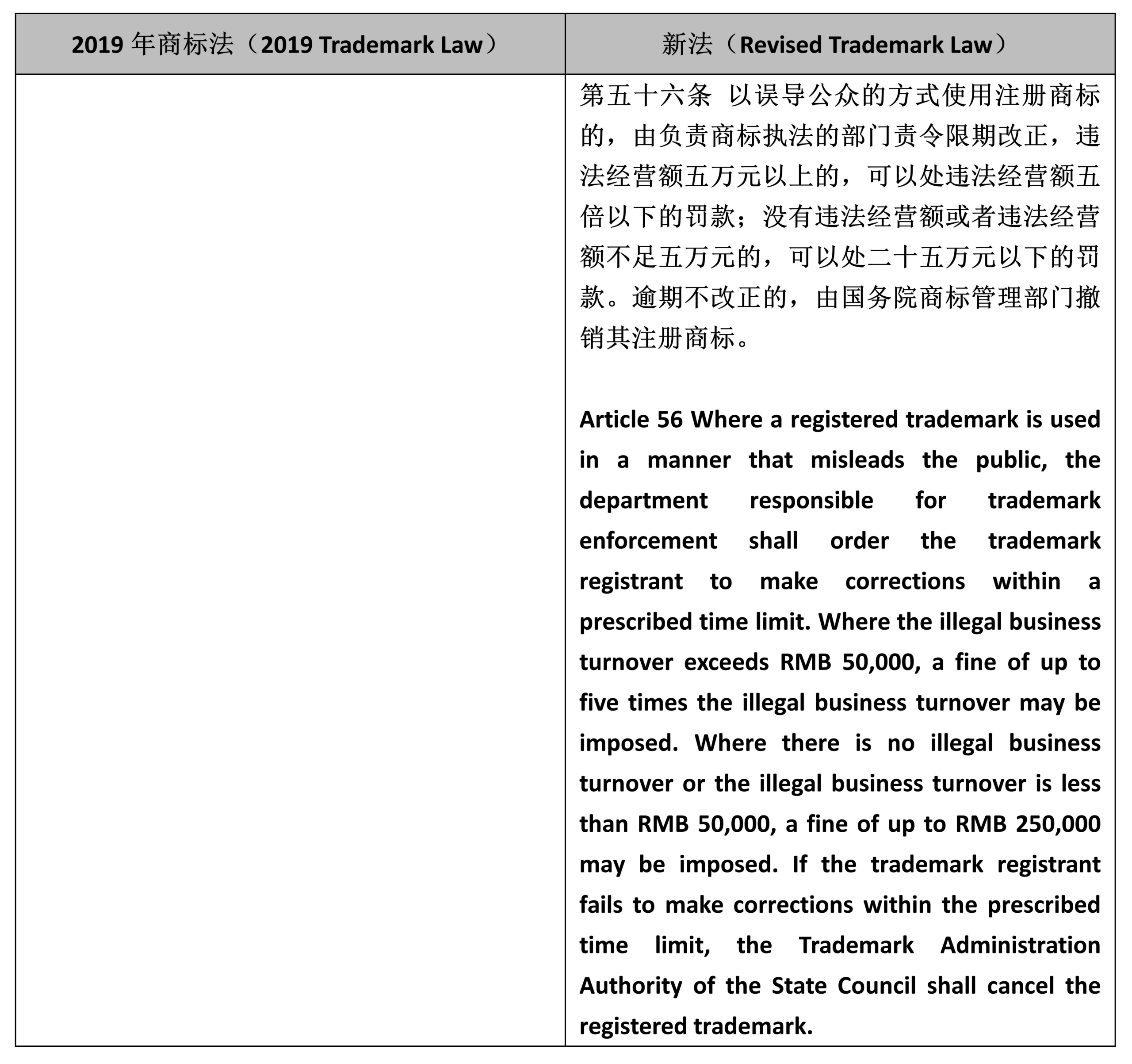
修改解读:新法新增了对以误导公众方式使用注册商标(“心机商标”)的行政处罚规定。除罚款外,逾期不改正的,还可能被撤销注册商标。品牌所有人应进一步规范注册商标的使用行为,避免因“心机商标”、擅自改变注册商标或者其他误导公众的行为而面临行政处罚甚至商标被撤销的法律风险。
Comments: The revised Law introduces administrative penalties for the misleading use of registered trademarks, including the use of so-called "deceptive marks" (心机商标). In addition to fines, failure to rectify the violation may result in cancellation of the registered trademark. Brand owners should ensure that their registered trademarks are used in compliance with the Law and avoid the use of deceptive marks, unauthorized alterations to registered trademarks, or other misleading practices that may expose them to administrative penalties or even cancellation of their trademark registrations.
14.新增依职权撤销通用名称或连续三年不使用注册商标 Ex Officio Cancellation of Generic or Unused Registered Trademarks
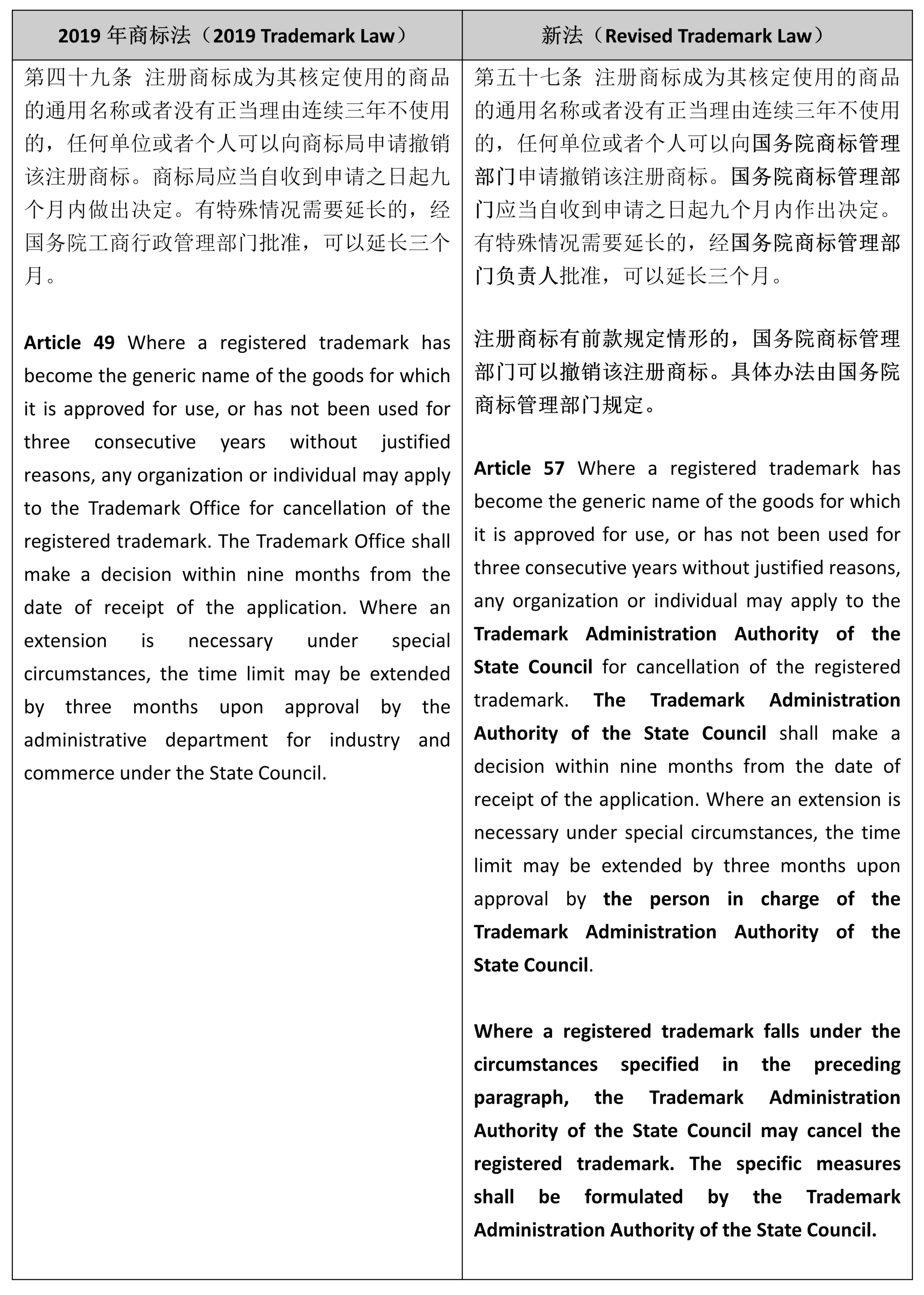
修改解读:2019年《商标法》规定,注册商标成为通用名称或者无正当理由连续三年不使用的,任何单位或者个人可以申请撤销。本次修法在保留申请撤销制度的基础上,新增规定国务院商标管理部门可以依职权撤销符合上述情形的注册商标。该修改有助于进一步清理闲置商标和已经退化为通用名称的注册商标,释放商标资源,但依职权撤销程序的具体适用标准和操作方式仍有待后续规定进一步明确。
Comments: The 2019 Trademark Law allowed any organization or individual to apply for cancellation of a registered trademark that has become generic or has not been used for three consecutive years without justified reasons. The revised Law retains this application-based cancellation mechanism and further authorizes the Trademark Administration Authority of the State Council to cancel such trademarks ex officio. This amendment may help clear unused trademarks and marks that have become generic, thereby releasing trademark resources. However, the specific standards and procedures for ex officio cancellation will need to be further clarified in future implementing rules.
15.新增集体商标、证明商标管理不当的行政处罚 Administrative Penalties for Improper Management of Collective and Certification Marks
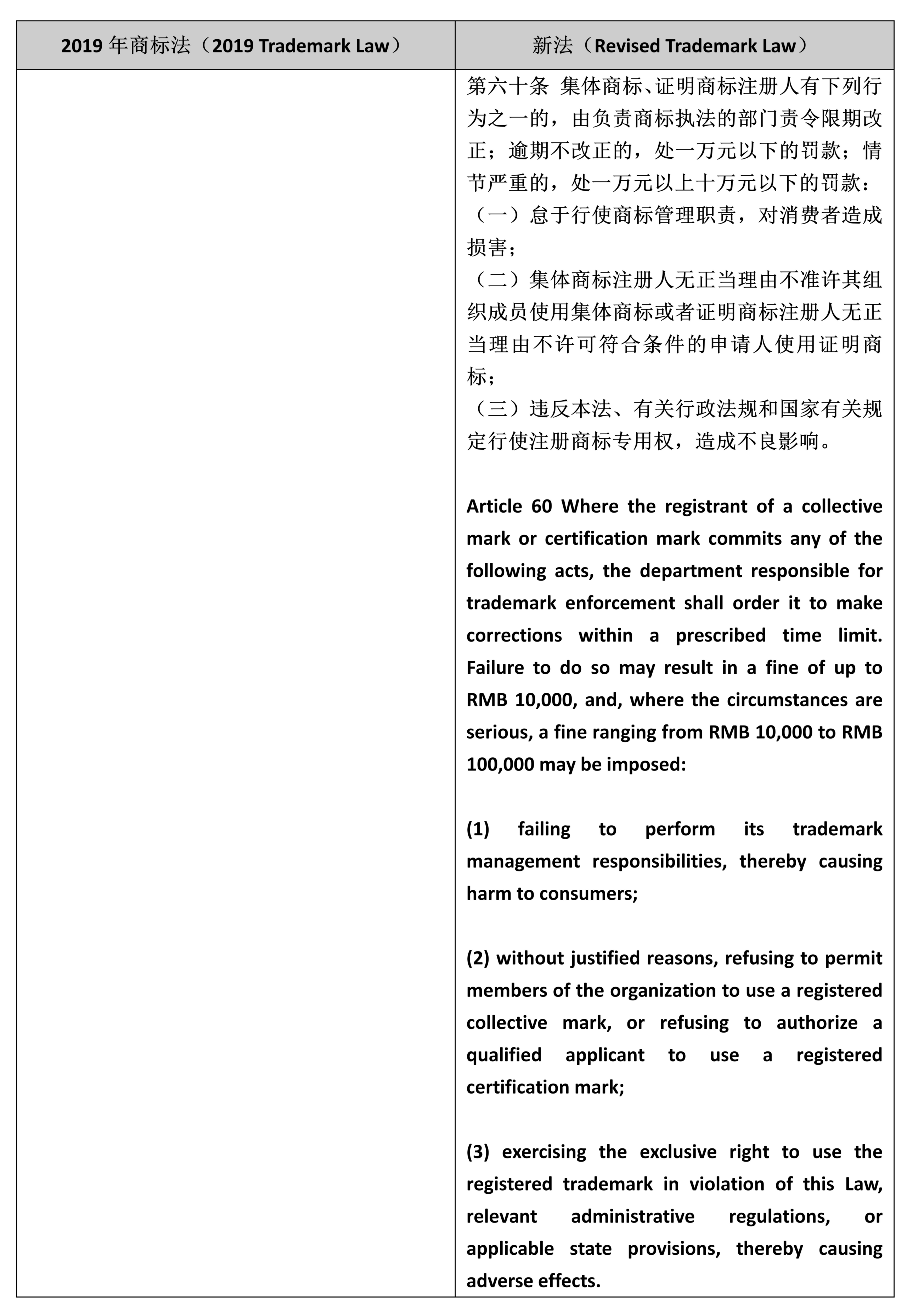
修改解读:新法新增了对集体商标、证明商标注册人未适当履行管理职责的行政处罚规则。集体商标和证明商标具有较强的公共管理和品质保证属性,注册人不仅享有商标权利,也负有相应的管理、监督和公平许可义务。该条也是对近年来集体商标、证明商标注册人不当维权、怠于管理或者不合理限制他人使用等问题的回应,有助于进一步规范集体商标、证明商标的管理和使用秩序。
Comments: The revised Law introduces administrative penalties for registrants of collective marks and certification marks that fail to properly perform their management responsibilities. Given the public management and quality assurance functions of these special types of trademarks, registrants are expected not only to exercise trademark rights, but also to fulfill corresponding management, supervision and fair licensing obligations. This provision also responds to recent concerns over improper enforcement, failure to manage, or unreasonable restrictions on the use of collective marks and certification marks, and may help further regulate their administration and use.
16.明确不正当竞争案件中的驰名商标认定 Well-Known Trademark Recognition in Unfair Competition Cases

修改解读:新法明确将驰名商标认定的适用场景扩展至不正当竞争案件。在查处或者审理不正当竞争案件过程中,当事人依法主张权利的,相关行政机关和人民法院可以根据案件需要,对商标驰名情况作出确认。该修改为品牌所有人在不正当竞争纠纷中主张驰名商标保护提供了更加明确的法律依据。
Comments: The revised Law expressly extends well-known trademark recognition to unfair competition cases. Where a party lawfully asserts its rights in the investigation or adjudication of an unfair competition case, the relevant administrative authority or court may determine the well-known status of the trademark as necessary. This provides brand owners with a clearer legal basis for seeking well-known trademark protection in unfair competition disputes.
17.加强商标代理机构监管 Enhanced Regulation of Trademark Agencies

修改解读:新法进一步加强了对商标代理机构的监管,扩大了禁止行为范围,并提高了行政处罚力度。商标代理机构在接受商标申请委托前,应更加审慎地开展合规审查。新规则在实践中如何执行,仍有待进一步观察。
Comments: The revised Law strengthens the regulation of trademark agencies by expanding prohibited conduct and increasing administrative penalties. Trademark agencies will need to conduct more thorough compliance reviews before accepting trademark filing instructions. How these new obligations will be enforced in practice remains to be seen.
18.新增商标代理从业人员行政责任 Administrative Penalties for Trademark Practitioners
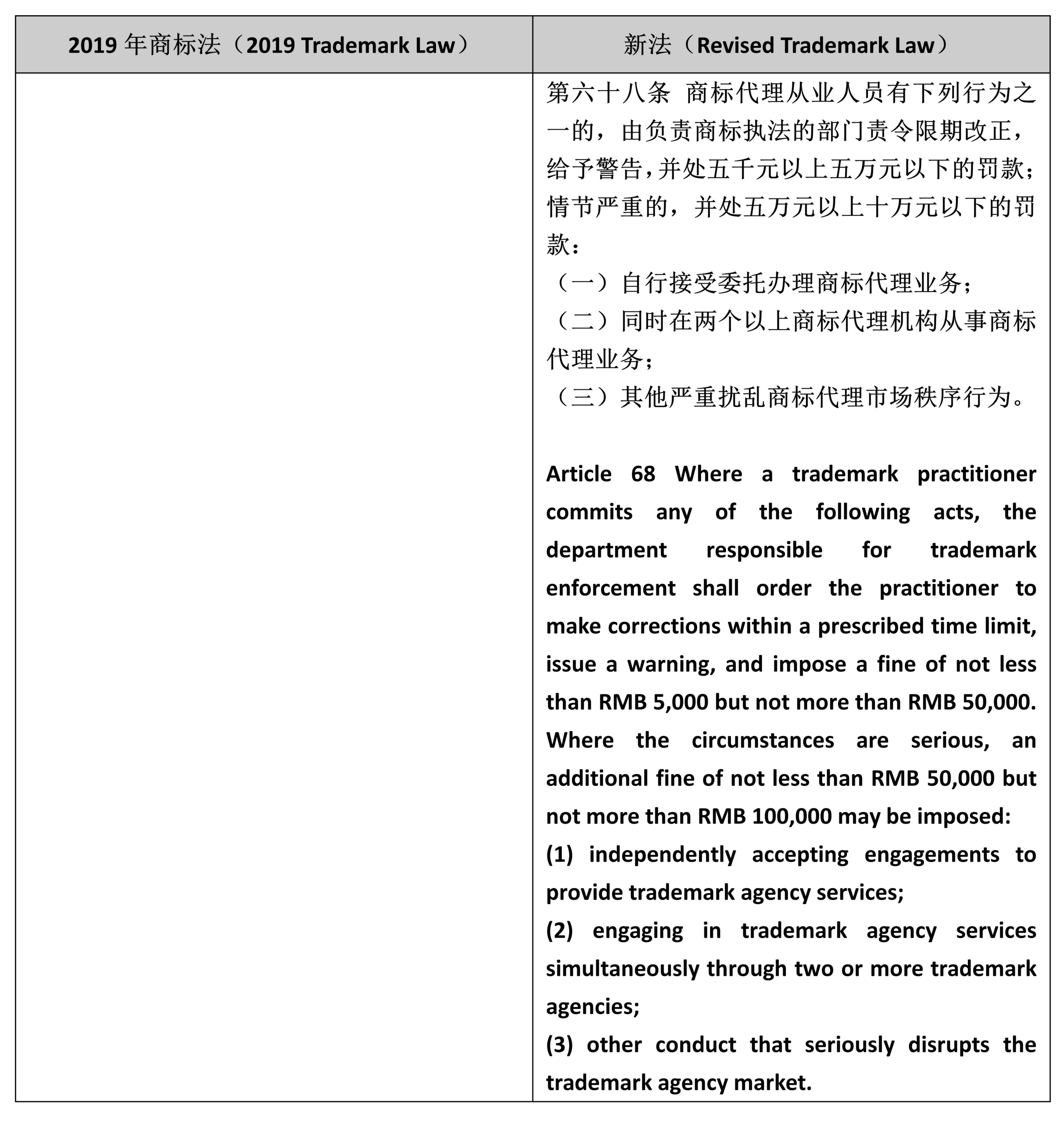
修改解读:新法新增了商标代理从业人员的直接行政责任。商标代理从业人员自行接受委托、同时在两个以上商标代理机构从事商标代理业务,或者存在其他严重扰乱商标代理市场秩序行为的,可能面临警告和罚款。该修改表明商标代理监管不再仅限于商标代理机构,也进一步延伸至具体从业人员。
Comments: The revised Law introduces direct administrative liability for trademark practitioners. Individual practitioners may be subject to warnings and fines if they independently accept engagements, provide trademark agency services through two or more agencies at the same time, or otherwise seriously disrupt the trademark agency market. This amendment indicates that regulatory enforcement is no longer limited to trademark agencies, but also extends to individual practitioners.
19.新增境外程序中的驰名商标确认机制 Well-Known Trademark Recognition for Overseas Proceedings
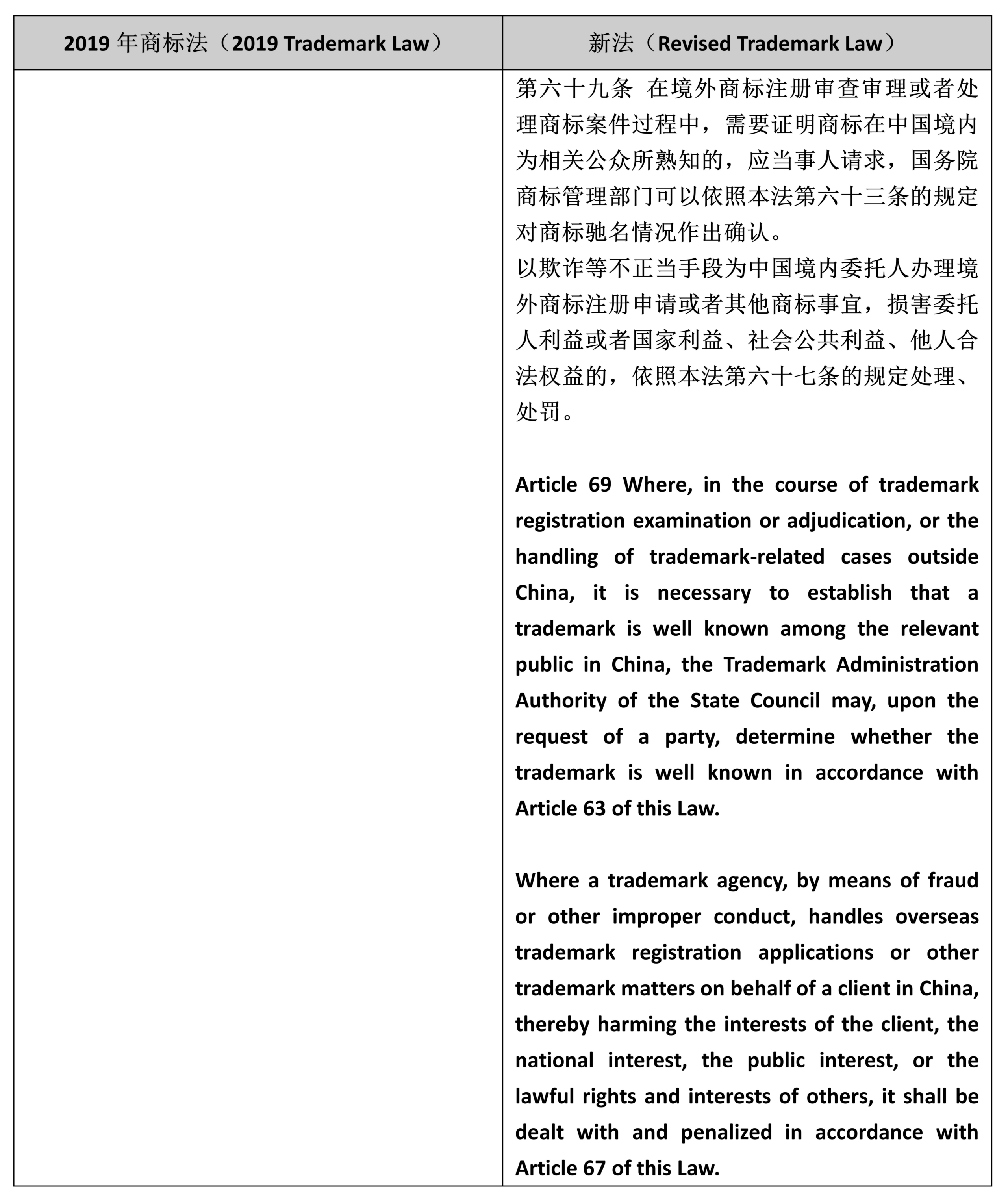
修改解读:新法新增了为境外商标注册审查审理或者处理商标案件提供驰名商标确认的机制。在境外程序中,如需要证明相关商标在中国境内为相关公众所熟知,当事人可以请求国务院商标管理部门对商标驰名情况作出确认。该机制有助于中国品牌所有人在境外应对恶意商标注册、商标争议或者其他商标案件时,提供来自中国主管机关的证明材料。
Comments: The revised Law introduces a mechanism for recognizing well-known trademarks for use in overseas trademark proceedings. Where it is necessary to prove that a trademark is well known among the relevant public in China in overseas trademark examination, adjudication or trademark-related cases, a party may request the Trademark Administration Authority of the State Council to determine the well-known status of the trademark. This may provide Chinese brand owners with useful evidence when combating bad-faith trademark registrations or other trademark disputes in foreign jurisdictions.
20.新增商标违法行为投诉举报机制 Public Reporting of Trademark Violations
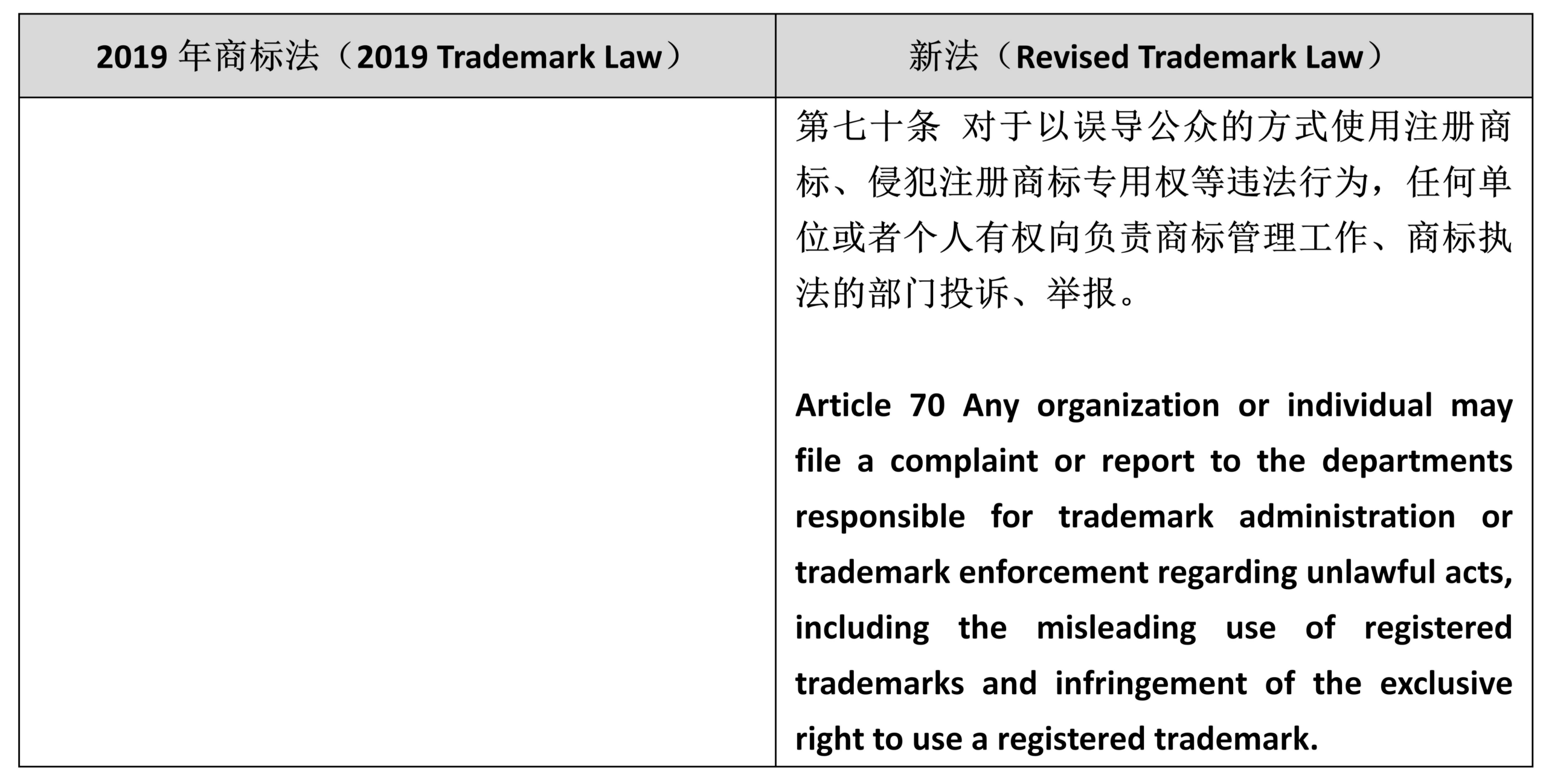
修改解读:新法明确任何单位或者个人均有权对误导性使用注册商标(“心机商标”),以及侵犯注册商标专用权等商标违法行为进行投诉、举报。该规定可以提高商标执法的主动性和覆盖面。
Comments: The revised Law expressly allows any organization or individual to file complaints or reports against trademark violations, including the misleading use of registered trademarks, namely the use of so-called “deceptive marks” (心机商标), and trademark infringement. This provision may make trademark enforcement more proactive and broader in coverage.
六、注册商标专用权的保护 Protection of the Exclusive Right to Use a Registered Trademark
21.明确指示性使用规则 Clarification of Indicative (Nominative) Use

修改解读:新法进一步明确了指示性使用规则。仅为说明商品用途、适用对象、应用场景等信息,或者表明商品真实来源而使用他人注册商标的,商标权人无权禁止他人正当使用,但容易导致混淆的除外。该修改为经营者合理指示性使用他人商标提供了更加明确的法律依据,也进一步划清了商标专用权保护与正当使用之间的边界。
Comments: The revised Law further clarifies the rules on indicative, or nominative, use. Where a registered trademark is used solely to indicate the purpose, intended users, application scenarios or true source of goods, the trademark owner has no right to prohibit such legitimate use, unless it is likely to cause confusion. This amendment provides a clearer legal basis for businesses to make legitimate referential use of another party’s trademark and further defines the boundary between trademark protection and fair use.
22.提高损害赔偿计算方式的灵活性 Flexibility in Calculating Damages
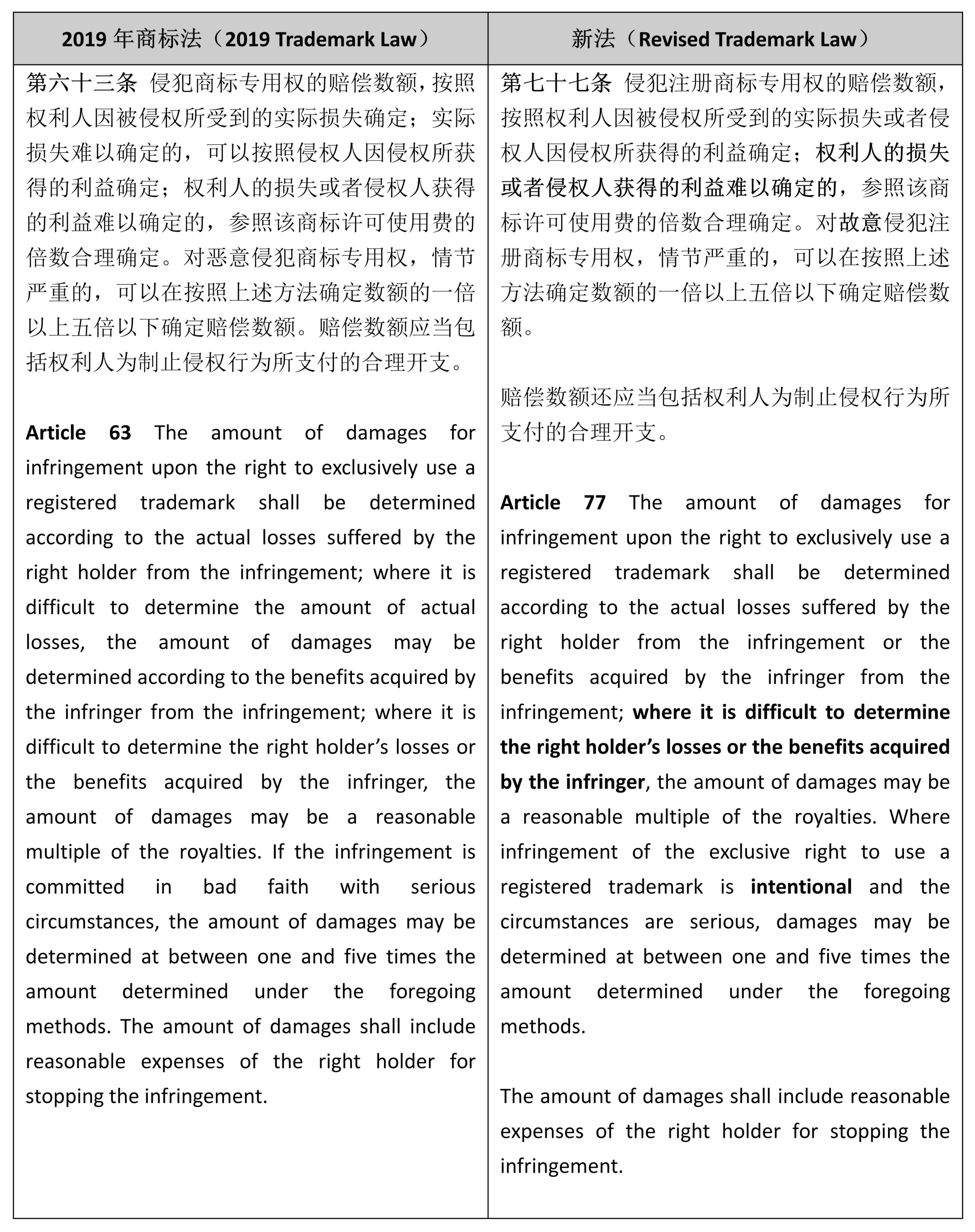
修改解读:新法调整了商标侵权损害赔偿的计算顺序,不再要求必须先以权利人实际损失为基础进行计算,再考虑侵权人获利。权利人可以根据案件具体情况,选择以其实际损失或者侵权人获利作为损害赔偿计算基础。该修改为权利人在商标侵权诉讼中主张损害赔偿提供了更大的灵活性。
Comments: The revised Law removes the sequential approach to calculating damages for trademark infringement. Rights holders may choose to base their damages claim on either their actual losses or the infringer’s gains, depending on the circumstances of the case. This amendment provides greater flexibility for rights holders in claiming damages in trademark infringement litigation.
23.明确请求损害赔偿时三年使用证据的计算期间 Three-Year Genuine Use Requirement for Damages
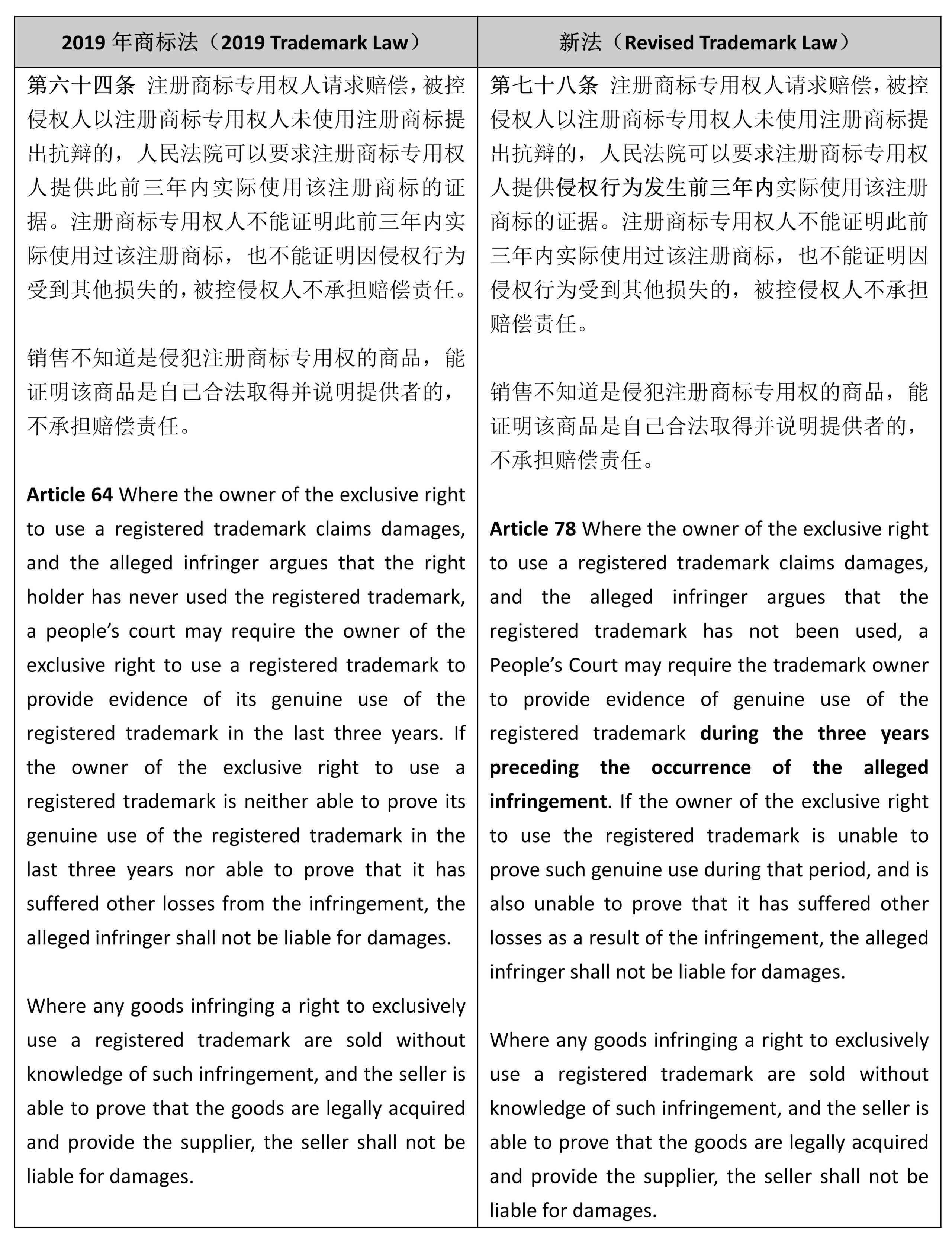
修改解读:新法明确,在商标侵权诉讼中,被控侵权人以注册商标未使用提出抗辩的,注册商标权人应提供侵权行为发生前三年内实际使用该商标的证据。该修改进一步明确了主张损害赔偿时三年使用证据的计算期间,有助于减少实务中对相关期间起算点的争议。
Comments: The revised Law clarifies that, where the alleged infringer raises a non-use defense in a trademark infringement case, the trademark owner may be required to provide evidence of genuine use during the three years preceding the alleged infringement. This amendment clarifies the relevant period for assessing genuine use in damages claims and may help reduce disputes over the starting point of that period.
24.明确恶意商标诉讼的民事责任 Civil Liability for Malicious Trademark Litigation
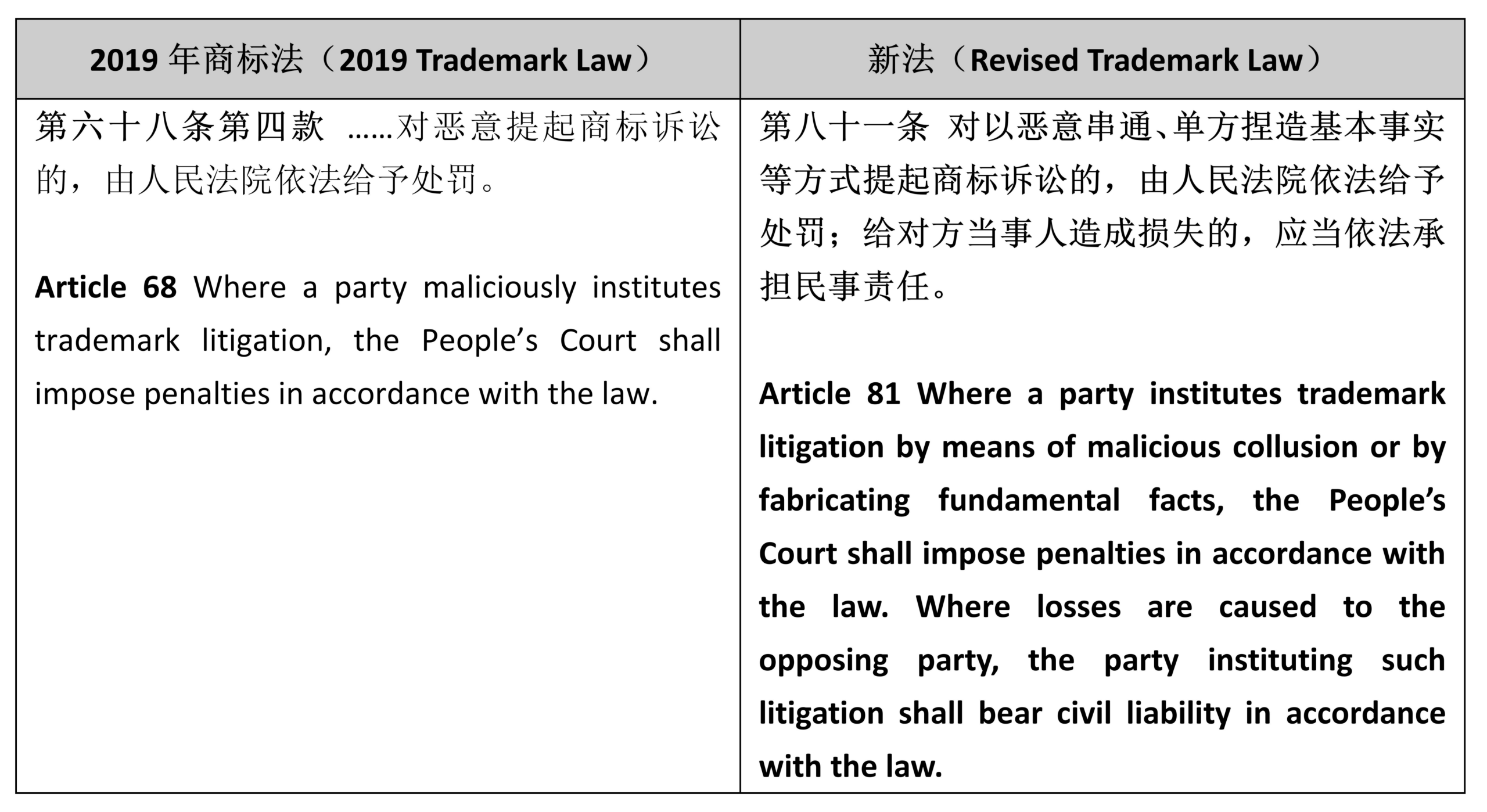
修改解读:2019年《商标法》已规定,恶意提起商标诉讼的,由人民法院依法给予处罚。新法将恶意商标诉讼的典型情形明确为恶意串通、单方捏造基本事实等方式,并规定给对方当事人造成损失的,应当依法承担民事责任。该修改进一步强化了对恶意商标诉讼和滥用商标权行为的规制。
Comments: The 2019 Trademark Law already provided that malicious trademark litigation shall be sanctioned by the People’s Court in accordance with the law. The revised Law further specifies typical forms of malicious trademark litigation, including malicious collusion and fabrication of fundamental facts, and expressly provides that a party bringing such litigation shall bear civil liability for losses caused to the opposing party. This amendment further strengthens the regulation of malicious trademark litigation and abuse of trademark rights.
25.强化公职人员的处分责任 Strengthened Accountability of Public Officials
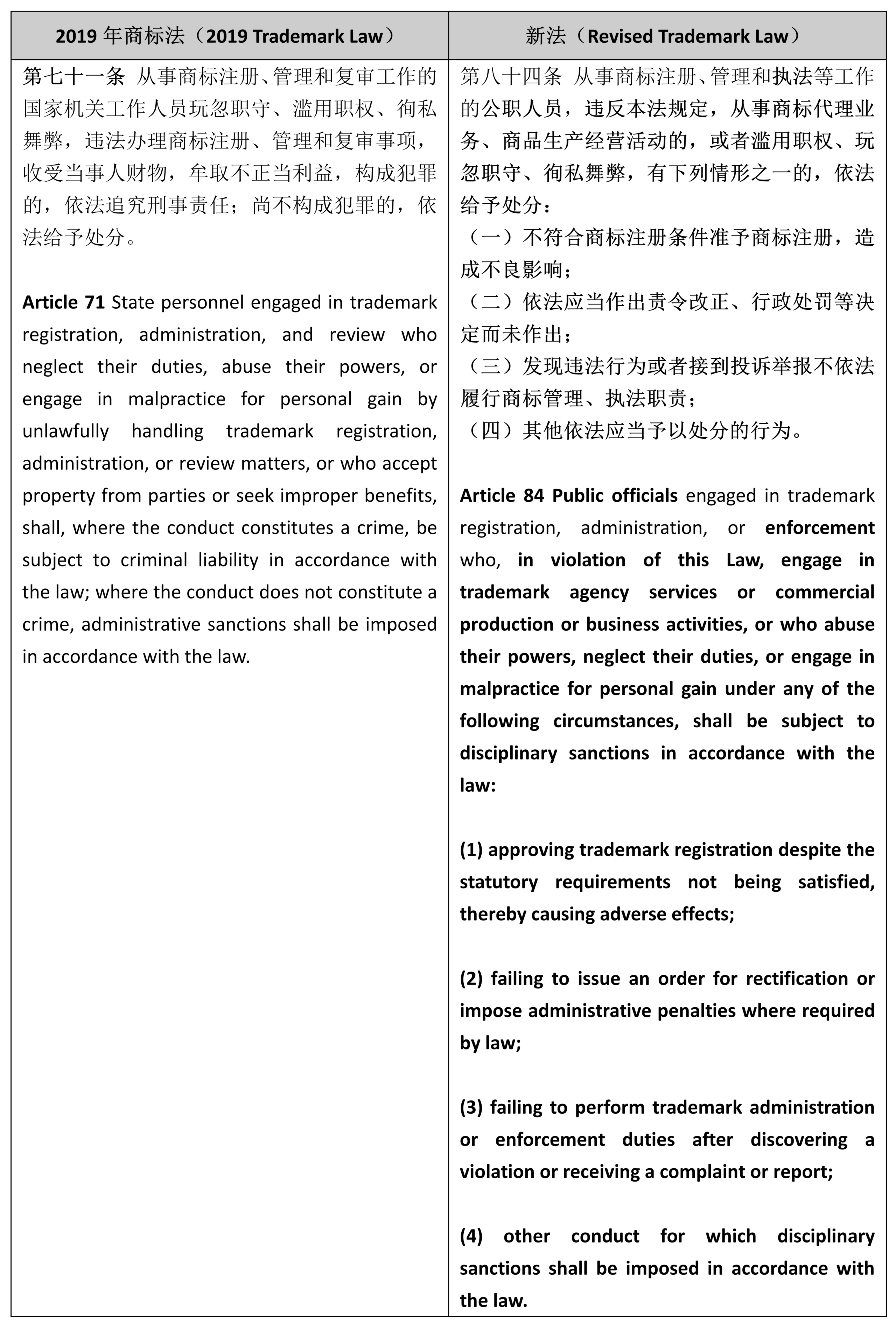
修改解读:新法进一步扩展了从事商标管理和执法工作的公职人员的处分责任,明确了更具体的追责情形,并加强了对商标监管机关的监督。可以合理预期,未来商标审查和执法工作可能会更加严格。
Comments: The revised Law expands the disciplinary obligations of public officials engaged in trademark administration and enforcement. It introduces more specific grounds for accountability and strengthens oversight of trademark regulatory authorities. It is reasonable to expect that trademark examination and enforcement may become more rigorous in practice.
七、结语 Conclusion
新修订《商标法》是我国商标法律制度的一次重要变革。与此同时,修订过程中一些曾引发广泛讨论的重要制度最终未被正式文本采纳,包括商标授权确权行政诉讼中的情势变更限制条款、五年一次的商标使用说明制度、恶意抢注商标强制移转制度、恶意抢注民事赔偿制度以及禁止重复注册制度等。这也反映出立法机关在强化商标治理与兼顾程序公平、行政效率和合理商业需求之间,采取了更为审慎的制度选择。
The revised Trademark Law represents an important reform of China’s trademark system. At the same time, several proposals that attracted considerable attention during the revision process were not retained in the final text, including the proposed restrictions on the doctrine of change of circumstances in trademark administrative litigation, the five-year trademark use statement system, compulsory transfer of bad-faith trademark registrations, civil compensation for bad-faith filings, and the prohibition on repeat trademark applications. These omissions suggest that the legislature has taken a more cautious approach in balancing stronger trademark regulation with procedural fairness, administrative efficiency, and legitimate business needs.